Special Update: What the 2026 Midterm Election Results Mean for Your Investments

Wyatt Lewis | Financial Advisor
November 4, 2026
The 2026 midterm elections have shifted control of Congress, with Democrats winning both the House and Senate. This creates a divided government for the final two years of President Trump's term. Divided government is actually quite common after midterm elections, and has occurred under many recent presidents.
Many observers see this result as a reflection of how voters feel about the economy, including concerns about tariffs and high oil prices tied to the conflict with Iran. But it is worth keeping things in perspective. Presidents and Congress often get too much credit or too much blame for economic conditions. Broader forces like technological change, inflation, and economic growth tend to have a greater impact on financial markets than election outcomes.
Consumer confidence has fallen to near-record lows
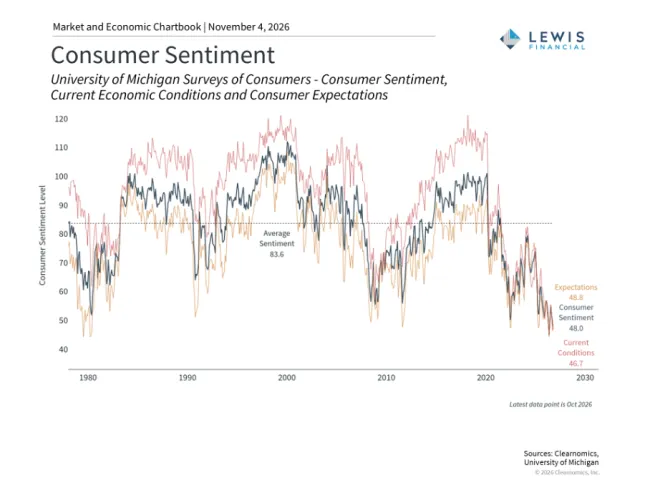
Voters' frustration with the economy was a major theme in this election. According to the AP's survey of voters, the economy was the single most important issue, and nearly 90% said the cost of living was a crucial or major factor in their vote.1 Everyday costs like gasoline, which is averaging $4.12 per gallon, a 30-year mortgage rate of around 7.3%, and Consumer Price Index (CPI) inflation of 3.7% in September have all weighed heavily on household budgets.
Interestingly, even as people feel pessimistic, overall consumer spending has held up. The economy grew at a 2.5% annual rate in the third quarter, which is historically strong.3 This gap between how people feel and how they actually spend is sometimes called the "K-shaped" economy, where some households benefit from rising markets while others feel the pinch of higher prices on food, fuel, and housing.
The key takeaway is that how people feel about the economy and how markets actually perform are not always the same thing. This is why it is important not to let sentiment or election results drive investment decisions.
Policy uncertainty has contributed to market swings
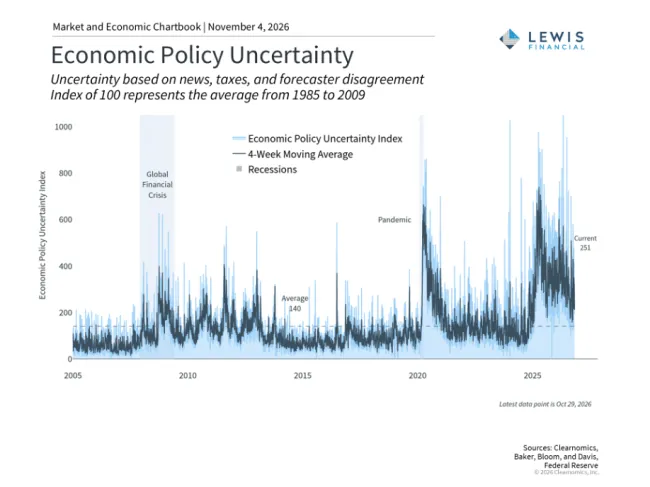
Uncertainty around policy, including tariffs, the One Big Beautiful Bill Act, the national debt, and the war in Iran, has contributed to short-term market volatility in recent years. In each case, markets experienced turbulence before settling down as investors refocused on economic fundamentals.
A divided government often means fewer sweeping policy changes, since major legislation requires agreement between parties. This can reduce uncertainty for businesses and markets, though challenges remain around the federal budget and debt ceiling in the months ahead. One closely watched area is the buildout of data centers for artificial intelligence (AI). Voters in at least 41 local areas considered measures on data center construction, with most results favoring new restrictions. Specifically, voters chose to limit data center development in 37 jurisdictions and to allow or support development in one, based in Harwood, North Dakota. One measure in Kansas banned "high-impact data centers," defined as facilities using more than ten megawatts of electricity or 100,000 gallons of water per day, for 10 years.4
The economy has expanded under many different governments
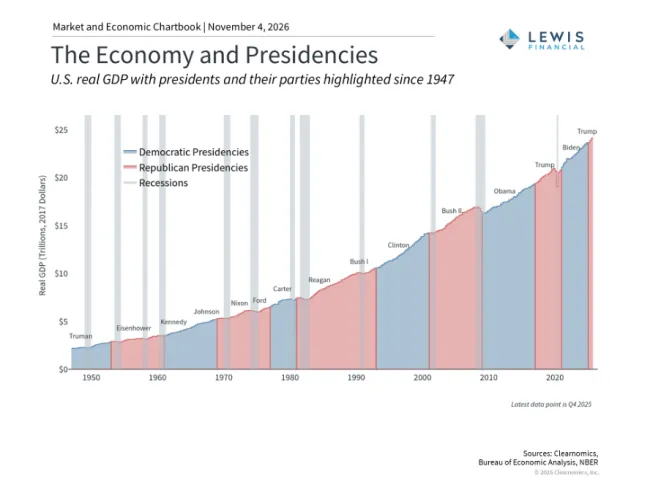
The chart above shows U.S. real GDP (economic output adjusted for inflation) going back to 1947 under many different political combinations. In each case, long-run growth was shaped by the broader business cycle and long-term trends, not by which party was in power.
This is not to say that policies around taxes, international relations, or government programs do not matter at all. But history shows they are rarely the main driver of long-term investment outcomes. As citizens and voters, elections are an important way to make our voices heard. When it comes to managing investments, though, it is wise to keep political views separate from financial decisions.
The bottom line? The midterm election results reflect voters' concerns about the economy and rising prices, but sentiment and political outcomes do not always translate directly to portfolio performance. Investors should continue to stay balanced and focused on long-term trends throughout political cycles.
References
1. https://apnews.com/article/midterms-trump-election-2026-democracy-economy-congress-young-voters-688773185f71690b00847726efbf045a
2. https://www.sca.isr.umich.edu/
3. https://www.bea.gov/data/gdp/gross-domestic-product
4.https://ballotpedia.org/El_Dorado,_Kansas,_Prohibit_Data_Centers_and_Battery_Energy_Storage_Systems_Initiative_(November_2026)
Securities and advisory services are offered through LPL Financial, Member FINRA/SIPC.
This material is for general information only and is not intended to provide specific advice or recommendations for any individual. There is no assurance that the views or strategies discussed are suitable for all investors or will yield positive outcomes. Investing involves risks including possible loss of principal. No investment strategy or risk management technique can guarantee return or eliminate risk in all market environments Any economic forecasts set forth may not develop as predicted and are subject to change.
References to markets, asset classes, and sectors are generally regarding the corresponding market index. Indexes are unmanaged statistical composites and cannot be invested into directly. Index performance is not indicative of the performance of any investment and do not reflect fees, expenses, or sales charges. All performance referenced is historical and is no guarantee of future results.
This information is not intended to be a substitute for specific individualized tax or legal advice. We suggest that you discuss your specific situation with a qualified tax or legal professional.
Bonds are subject to market and interest rate risk if sold prior to maturity. Bond values will decline as interest rates rise and bonds are subject to availability and change in price.
U.S. Treasury securities are guaranteed by the federal government as to the timely payment of principal and interest. The principal value of Treasury securities and other bonds fluctuates with market conditions.
International investments carry additional risks, which include differences in financial reporting standards, currency exchange rates, political risks unique to a specific country, foreign taxes and regulations, and the potential for illiquid markets. These factors may result in greater share price volatility.
This material was prepared by Clearnomics, Inc., who is not affiliated with the named financial professional, firm or broker/dealer.
Copyright (c) 2026 Clearnomics, Inc. All rights reserved. The information contained herein has been obtained from sources believed to be reliable, but is not necessarily complete and its accuracy cannot be guaranteed. No representation or warranty, express or implied, is made as to the fairness, accuracy, completeness, or correctness of the information and opinions contained herein. The views and the other information provided are subject to change without notice. All reports posted on or via www.clearnomics.com or any affiliated websites, applications, or services are issued without regard to the specific investment objectives, financial situation, or particular needs of any specific recipient and are not to be construed as a solicitation or an offer to buy or sell any securities or related financial instruments. Past performance is not necessarily a guide to future results. Company fundamentals and earnings may be mentioned occasionally, but should not be construed as a recommendation to buy, sell, or hold the company's stock. Predictions, forecasts, and estimates for any and all markets should not be construed as recommendations to buy, sell, or hold any security--including mutual funds, futures contracts, and exchange traded funds, or any similar instruments. The text, images, and other materials contained or displayed in this report are proprietary to Clearnomics, Inc. and constitute valuable intellectual property. All unauthorized reproduction or other use of material from Clearnomics, Inc. shall be deemed willful infringement(s) of this copyright and other proprietary and intellectual property rights, including but not limited to, rights of privacy. Clearnomics, Inc. expressly reserves all rights in connection with its intellectual property, including without limitation the right to block the transfer of its products and services and/or to track usage thereof, through electronic tracking technology, and all other lawful means, now known or hereafter devised. Clearnomics, Inc. reserves the right, without further notice, to pursue to the fullest extent allowed by the law any and all criminal and civil remedies for the violation of its rights.